
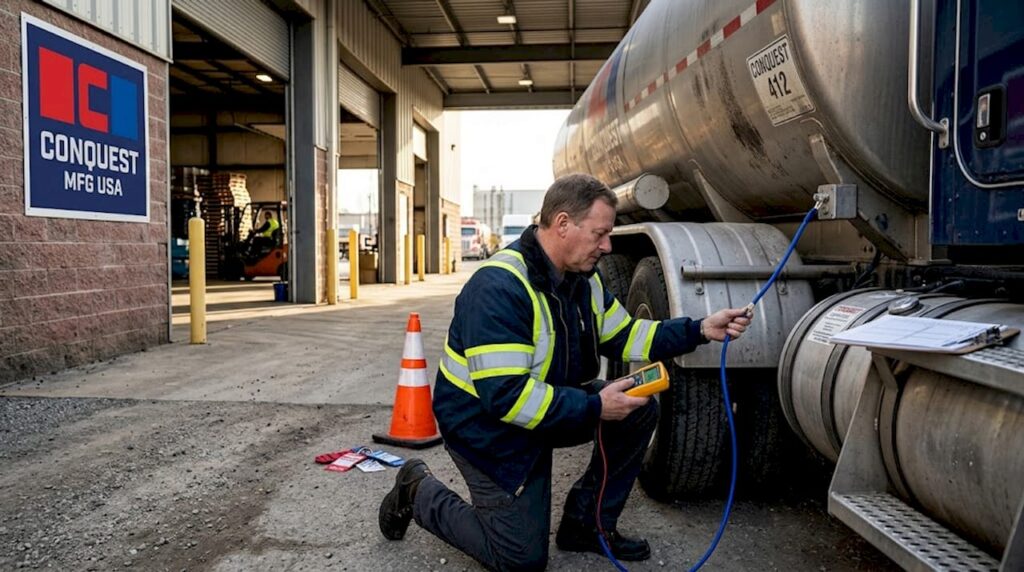
Transporting vacuum tanks through active oil fields or construction zones is not a routine logistics task. A single grounding failure or missing work permit can trigger a fire, a regulatory shutdown, or a liability claim that costs your operation far more than any load is worth. Transport and logistics managers in the construction and oil industries face mounting pressure to keep operations moving while staying fully compliant with industry safety standards. This guide walks you through the regulatory foundation, preparation steps, execution protocol, and post-transport verification process you need to move vacuum tanks safely and confidently every time.
Table of Contents
- Key standards and requirements for safe vacuum tank transport
- Preparation: Tools, permits, and team readiness
- Execution: Step-by-step vacuum tank transport protocol
- Verification and troubleshooting: Compliance checks and common pitfalls
- Expert perspective: What most guides miss about vacuum tank transport safety
- Find equipment and compliance solutions for vacuum transport
- Frequently asked questions
Key Takeaways
| Point | Details |
|---|---|
| Follow industry standards | Adhering to API RP 2219 is crucial for safety and regulatory compliance in vacuum tank transport. |
| Thorough preparation | Check all permits, tools, and assign roles before every transport to prevent errors. |
| Step-by-step protocol | Use clear procedural instructions for securing tanks and monitoring during transit. |
| Verify and troubleshoot | Post-transport checks and digital recordkeeping help identify and correct compliance issues. |
| Expert oversight matters | Involving safety professionals and leveraging digital monitoring maximizes both safety and results. |
Key standards and requirements for safe vacuum tank transport
Having established the risks, the next step is understanding the industry’s definitive safety standards and required equipment before your team touches a single hose or coupling.
The primary reference document for vacuum truck operations in petroleum service is API RP 2219, which provides safe operating guidelines covering grounding procedures, hose selection, pump requirements, and approved off-loading methods. This standard is not optional guidance. Refineries and oil sites across the country reference it directly in their contractor requirements, and failure to comply can result in immediate site removal, fines, or worse.
Here is what API RP 2219 requires at a practical level:
- Grounding: Continuous grounding must be maintained throughout loading and off-loading. Grounding continuity must read less than 10 ohms at all times.
- Pump selection: When handling materials with a flash point below 140°F, only liquid ring pumps are permitted. These pumps must not exceed 1300 CFM capacity.
- Hose selection: Hoses must be rated for the specific material being transferred, including chemical compatibility and pressure ratings.
- Off-loading methods: Only three methods are approved: gravity discharge, pump-off, and pressure off-loading. Any deviation requires explicit site authorization.
Understanding these requirements is the foundation for vacuum tank safety requirements that protect your crew, your equipment, and your client relationships.
Regulatory requirements vs. common industry practices
| Requirement | API RP 2219 Standard | Common Field Practice |
|---|---|---|
| Grounding continuity | Less than 10 ohms | Often unchecked |
| Pump type (flammables) | Liquid ring only | Mixed pump types used |
| Max pump capacity | 1300 CFM | Frequently exceeded |
| Off-loading method | Gravity, pump-off, pressure | Improvised methods |
| MSDS on site | Mandatory | Sometimes missing |
| Work permits | Required for unknowns | Often skipped |
The gap between what the standard requires and what happens in the field is where most incidents originate. Managers who enforce the left column consistently are the ones who avoid the incidents that show up in the right column.
Pro Tip: Before any transport involving cargo of unknown composition, pull the worksite permit requirements and cross-reference them with your MSDS documentation. Never assume a material is non-flammable based on its label alone. Unknown cargo at oil sites frequently contains residual hydrocarbons that push it below the 140°F flash point threshold.
The consequences of compliance failure are serious. Sites operating under security manufacturing standards and refinery contractor agreements can face contract termination for a single documented violation. Beyond contract penalties, OSHA citations for hazardous materials mishandling carry fines that regularly exceed $15,000 per violation per day.
Preparation: Tools, permits, and team readiness
With standards understood, the next step is prepping your operation with the right tools and paperwork before the truck leaves the yard.
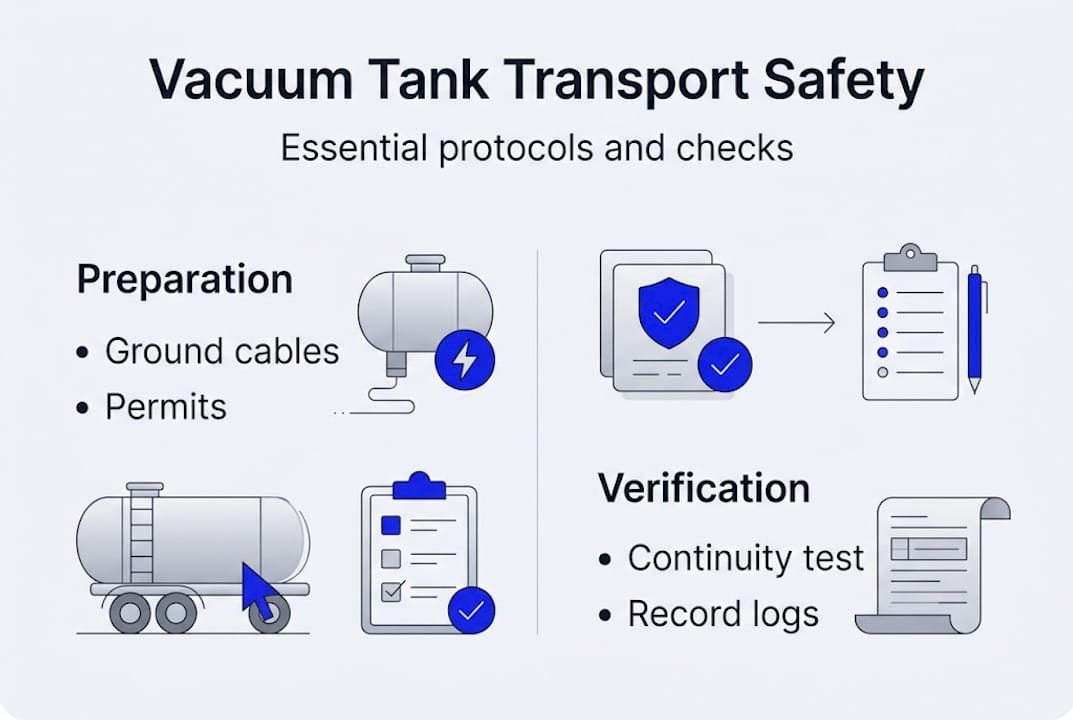
Preparation is where most preventable incidents are actually stopped. A team that arrives on site without grounding cables, or a driver who cannot produce a current MSDS for the cargo, creates a compliance failure before a single valve is opened. Structured preparation eliminates those gaps.
Here is the preparation sequence your team should follow:
- Confirm cargo identity and flash point. Pull the MSDS for every material being transported. If the flash point is below 140°F, confirm that a liquid ring pump is installed and rated for the job.
- Inspect grounding cables and continuity equipment. Test grounding continuity before departure. The reading must be below 10 ohms. Replace any cable that fails the test.
- Verify pump type and capacity. Confirm the installed pump matches the cargo requirements. For flammable materials, liquid ring pumps max 1300 CFM is the hard limit.
- Assemble spill kits. Every transport unit must carry a spill kit rated for the material being moved. Verify contents before departure, not on arrival.
- Secure work permits. For oil sites, this includes standard work permits and hot work permits if any heat-generating activity is involved near the tank. Permit verification should happen the day before transport, not the morning of.
- Assign team roles. Designate a driver, a safety officer, and a compliance manager for each transport. Each role has defined responsibilities during loading, transit, and off-loading.
Tools and permits preparation matrix
| Item | Responsible Role | Verification Timing |
|---|---|---|
| Grounding cables and tester | Driver | Pre-departure |
| Liquid ring pump check | Driver/Safety Officer | Pre-departure |
| Spill kit inspection | Safety Officer | Pre-departure |
| MSDS documentation | Compliance Manager | Pre-departure |
| Work permit | Compliance Manager | Day before transport |
| Hot work permit (if applicable) | Compliance Manager | Day before transport |
| Hose compatibility check | Driver | On-site before loading |
This matrix is not just a checklist. It assigns accountability, which is what makes it effective. When every item has a named role attached to it, nothing falls through the cracks because everyone assumed someone else handled it.
Pro Tip: Schedule permit verification the day before transport, not the morning of. Oil site permit offices often have processing delays, and a missing hot work permit will ground your operation on arrival. Build a one-day buffer into every schedule involving unknown or flammable cargo.
For managers looking to standardize these preparation workflows across their fleet, reviewing the transport solutions overview available from equipment manufacturers who specialize in vacuum tank systems is a productive starting point.
Execution: Step-by-step vacuum tank transport protocol
Now that preparation is complete, it’s time to execute the safe transport protocol in clear, repeatable steps.
Execution is where preparation either pays off or exposes its gaps. A well-prepared team moves through this protocol efficiently. A team that skipped preparation steps will encounter problems at every stage.
Follow this sequence for every transport:
- Establish grounding before any connection is made. Attach grounding cables to the tank and verify continuity reads below 10 ohms. Do not open any valve or connect any hose until grounding is confirmed.
- Inspect and connect hoses. Verify hose ratings match the cargo material. Connections must be secure and leak-free before loading begins.
- Verify ventilation. Confirm the vehicle and loading area have adequate ventilation. Enclosed spaces with flammable vapors are a fire risk even with proper grounding.
- Display MSDS documentation. The material safety data sheet must be accessible to all personnel on site and to emergency responders. Post it visibly in the cab.
- Begin loading under continuous monitoring. Monitor pressure gauges and grounding continuity throughout the loading process. Any reading outside spec requires an immediate stop.
- Secure the tank for transit. Confirm all valves are closed and locked, all hatches are sealed, and all connections are secured before the vehicle moves.
- Activate GPS and pressure monitoring for transit. Real-time GPS and pressure monitoring for hazmat transport is a recognized best practice. It gives your team and your client visibility into the load status throughout the route.
- Execute approved off-loading only. On arrival, approved off-loading methods are gravity discharge, pump-off, and pressure off-loading. Confirm which method is authorized by the receiving site before beginning.
Safety warning: Improper off-loading is one of the leading causes of vacuum tank incidents. Never use an off-loading method that has not been explicitly approved by the receiving site and confirmed against your work permit. Improvised pressure off-loading without site authorization has caused tank failures and vapor releases that resulted in fires and regulatory shutdowns.
Pro Tip: Invest in a real-time monitoring system that logs pressure and GPS data continuously during transit. This data is not just a safety tool. It is compliance documentation that protects your operation if a post-transport dispute arises about load handling.
For a detailed look at transport safety best practices that align with these execution steps, your equipment supplier is a valuable resource for both technical guidance and compliant equipment selection.
Verification and troubleshooting: Compliance checks and common pitfalls
After transport, verification ensures both safety and regulatory compliance, with clear solutions to the challenges that come up most often in the field.
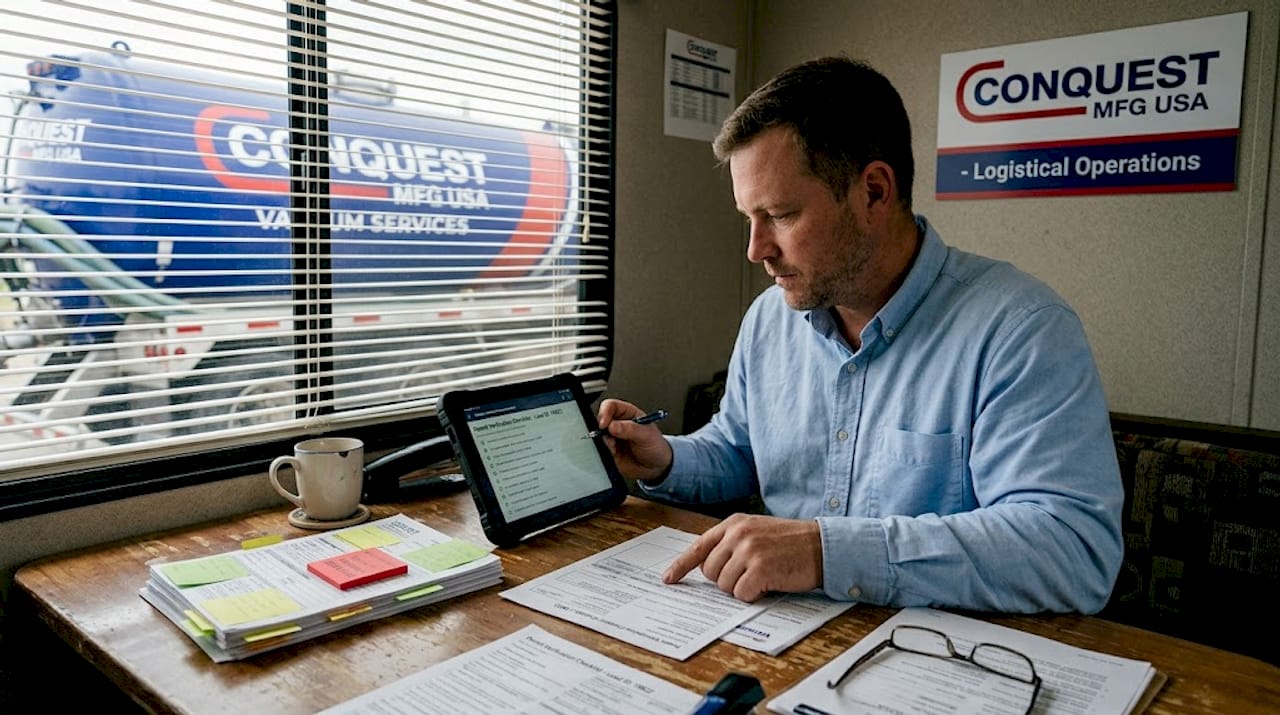
Post-transport verification is the step that many operations treat as optional. It is not. Regulators and site safety auditors increasingly require documented post-transport inspections, and the records you generate here are your defense in any compliance review.
Post-transport inspection checklist:
- Confirm grounding cables were maintained and log the final continuity reading
- Review pump-off logs for any pressure anomalies during transit or off-loading
- Verify MSDS documentation was present throughout transport and file it with the trip record
- Inspect hoses and connections for wear, damage, or residue that indicates a leak
- Confirm spill kit is intact or document any materials used and replace them immediately
- File all work permits with timestamps and signatures from receiving site personnel
Common problems and how to fix them
Grounding faults: If continuity testing shows a reading above 10 ohms, stop all operations immediately. Inspect cables for corrosion, damaged clamps, or broken continuity along the cable length. Replace the faulty component and retest before resuming. Grounding continuity below 10 ohms is a hard compliance requirement, not a guideline.
Incorrect off-loading method used: If a driver used an unauthorized off-loading method, document it immediately and report it to your compliance manager. Conduct a corrective action review and retrain the driver before the next assignment. Notify the receiving site and confirm no environmental release occurred.
Missing permits discovered on arrival: If a required work permit is missing on arrival, do not begin any operation. Contact your compliance manager to initiate emergency permit processing through the site’s permit office. In most cases, this means a same-day delay. It is always better than the alternative.
Pro Tip: Move your compliance documentation to a digital recordkeeping system. Digital logs with timestamps, GPS data, and photo documentation are far more defensible in a regulatory audit than paper checklists. Several field-ready apps are designed specifically for hazmat transport compliance documentation.
For operations that need additional compliance support solutions beyond internal processes, working with manufacturers who understand the regulatory environment for vacuum tank equipment is a practical next step.
Expert perspective: What most guides miss about vacuum tank transport safety
Most compliance guides focus entirely on the technical requirements. Follow the standard, check the boxes, file the paperwork. That approach keeps you compliant on paper. It does not always keep your people safe.
The real risk in vacuum tank transport is not the regulation you forgot. It is the cargo you did not fully understand before the truck left the yard. Unknown cargo composition is the most common factor in incidents we see referenced across oil site safety reports. A material labeled as “waste oil” can contain residual solvents, water, or hydrocarbon fractions that push its flash point well below 140°F. Without a proper MSDS review and flash point test, your team may be running a liquid ring pump requirement they do not know they have.
The second gap is the human factor. Checklists work when people use them consistently. The operations that perform best on safety audits are not the ones with the most detailed checklists. They are the ones where safety officers are present throughout the process, not just at the start and end. A safety officer who walks the loading area, confirms grounding continuity personally, and reviews the off-loading authorization with the receiving site is worth more than any form.
Continuous monitoring technology is closing some of this gap. Real-time pressure and GPS data give managers visibility they did not have five years ago. But technology supports good process. It does not replace it.
Our perspective, built from years of manufacturing vacuum tanks and working alongside logistics teams in the oil and construction industries, is that the insights on logistics safety that matter most come from treating every transport as a unique operation, not a routine one. The moment a team treats vacuum tank transport as routine is the moment they stop checking the things that matter.
Find equipment and compliance solutions for vacuum transport
If this guide has clarified what your operation needs to meet the standards, the next step is making sure your equipment is built to support that level of compliance.

At Conquest Manufacturing, we build steel and aluminum vacuum tanks designed specifically for the demands of oil and construction transport. Our equipment is engineered with the grounding, pump compatibility, and structural integrity that API RP 2219 compliance requires. Whether you need construction tank solutions for a specific site application or a broader review of your transport industry compliance equipment setup, we are ready to work with you directly. We also manufacture portable surveillance towers and security infrastructure manufacturing solutions that support site safety across your entire operation. Get a Quote today and let us build the right solution for your transport requirements.
Frequently asked questions
What is API RP 2219 and why is it important for vacuum tank transport?
API RP 2219 provides safe operating guidelines for vacuum trucks in petroleum service, defining requirements for grounding, pump selection, hose compatibility, and off-loading methods that protect against fire, spill, and regulatory violations.
What type of pump is required for transporting flammable liquids in vacuum tanks?
Liquid ring pumps max 1300 CFM are required for any material with a flash point below 140°F, as specified by API RP 2219 and standard refinery contractor requirements.
What documentation and equipment must accompany a vacuum tank during transport?
You must carry grounding cables, spill kits, and MSDS documentation, with real-time GPS and pressure monitoring strongly recommended for hazmat loads, along with all required work and hot work permits.
How do you verify grounding during vacuum tank transport?
Grounding continuity below 10 ohms must be confirmed before loading begins and maintained throughout the operation, with the reading logged as part of your compliance documentation.
What are the approved vacuum tank off-loading methods?
The three approved off-loading methods under API RP 2219 are gravity discharge, pump-off, and pressure off-loading, each of which must be authorized by the receiving site before use.