
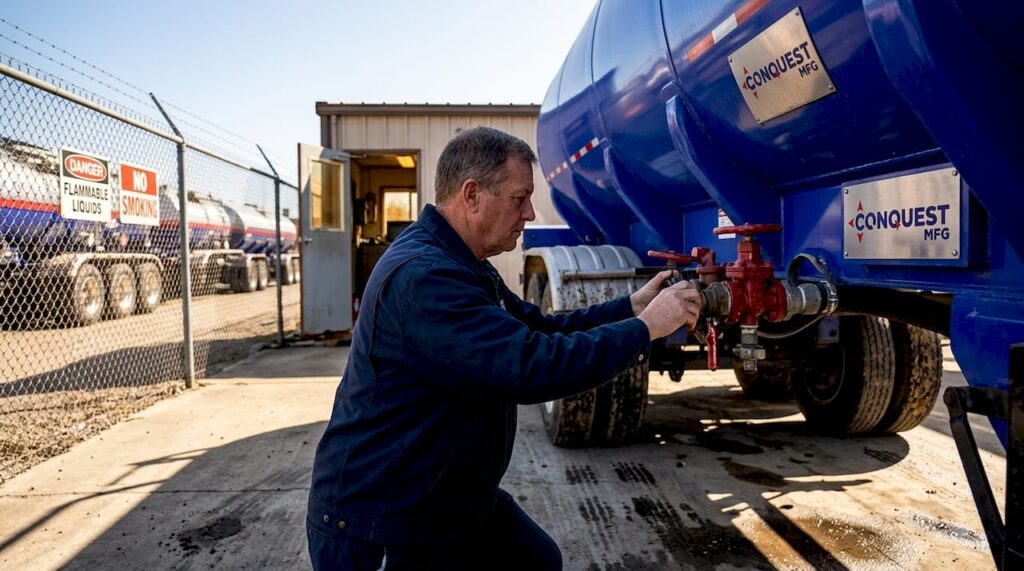
Most people assume a semi trailer is just a big box on wheels. In the oil sector, that assumption is costly. The role of semi trailers in oil industry operations spans specialized engineering, federal compliance, spill prevention, and supply chain performance. These are not commodity vehicles. They are precision instruments built to handle one of the most regulated and hazardous cargo categories in commercial transport. Understanding what these trailers actually do, and how they do it, is foundational knowledge for anyone managing logistics, policy, or procurement in the oil and gas space.
Table of Contents
- Key takeaways
- The role of semi trailers in oil industry transport
- Safety and regulatory compliance requirements
- Operational challenges and logistics solutions
- Economic significance in the 2026 oil sector
- Best practices for trailer performance and compliance
- My perspective on where oil trailer logistics is heading
- Purpose-built trailers for oil industry operations
- FAQ
Key takeaways
| Point | Details |
|---|---|
| Trailer type determines compliance | Different oil cargo types require specific trailer designs to meet DOT and EPA regulatory standards. |
| Vapor recovery is non-negotiable | Trailers must integrate vapor recovery systems under federal air quality rules to prevent hazardous emissions. |
| Non-compliance costs are severe | Clean Water Act fines for spill violations can exceed $50,000 per day, making proper containment financially critical. |
| Fleet modernization reduces costs | Aerodynamic and lightweight trailer designs lower fuel consumption and offset rising freight costs in 2026. |
| Digital tools prevent downtime | Real-time trailer intelligence enables predictive maintenance, reducing unplanned failures and spill incidents. |
The role of semi trailers in oil industry transport
The oil industry relies on several distinct trailer configurations, each engineered for a specific function. Choosing the wrong type is not just an operational mistake. It is a regulatory and safety failure.
Tank trailers are the most recognized format. They carry liquid petroleum products including crude oil, diesel, gasoline, and lubricants. Most are built to DOT 406 or 407 specifications depending on pressure requirements, and they feature multiple internal compartments that allow operators to transport different products simultaneously without cross-contamination.
Flatbeds and lowboys handle the heavy equipment side of oil logistics. Drilling machinery, wellhead components, production equipment, and pressure vessels all move on these platforms. The lowboy’s reduced deck height is specifically designed to accommodate tall or oversized loads while staying within legal height restrictions.
Pneumatic trailers serve the dry bulk segment, moving materials like cement, sand, and proppant used in hydraulic fracturing operations. You can learn more about why pneumatic trailers outperform conventional alternatives for this type of cargo.
Here is a direct comparison of the primary trailer types used in oil sector logistics:
| Trailer Type | Primary Use | Key Design Feature |
|---|---|---|
| DOT 406 tank trailer | Fuel and petroleum liquids | Multi-compartment, vapor recovery ports |
| Lowboy | Heavy drilling equipment | Low deck height, high payload capacity |
| Flatbed | General oilfield equipment | Open platform, versatile load securement |
| Pneumatic dry bulk | Cement, sand, proppant | Pressurized discharge system |
| Vacuum tank | Waste fluids, produced water | Sealed vessel, negative pressure unload |
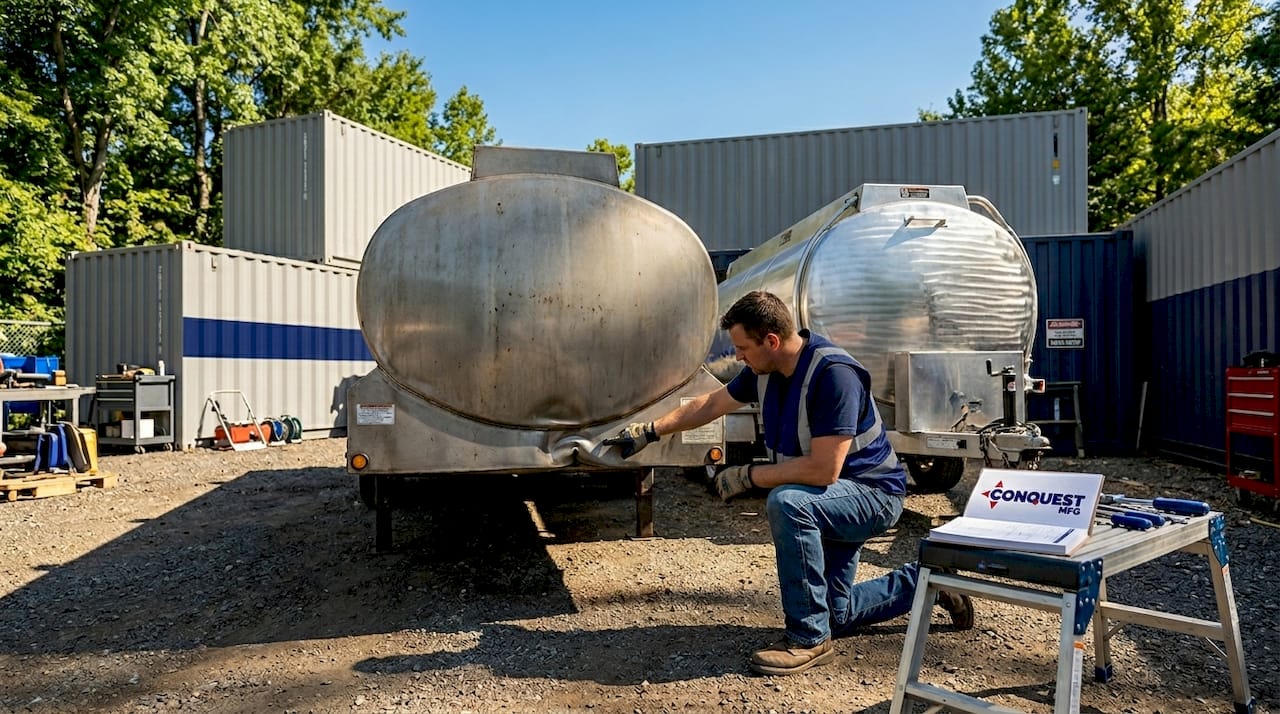
Material choice also matters considerably. Steel vacuum tanks offer higher durability under abrasive or corrosive loads, while aluminum tanks reduce tare weight and increase legal payload. The tradeoffs between steel and aluminum tanks affect both operating economics and cargo compatibility across different oil field environments.
Safety and regulatory compliance requirements
Regulatory requirements governing semi trailers in oil transport are extensive, and the penalties for missing them are not administrative formalities. They are business-ending liabilities.
The foundational standard for petroleum fuel tankers is DOT 406 specification, which mandates vapor recovery connections under 40 CFR 63 Subpart CCCCCC. Drivers operating these trailers must hold a CDL Class A license with an “X” endorsement, combining the hazardous materials designation (H) with the tanker endorsement (N). This is not optional. Operating without proper endorsements exposes the operator and the carrier to federal penalties.
On the environmental side, the EPA’s Spill Prevention, Control, and Countermeasure program governs facilities handling oil in significant quantities. Facilities storing above 1,320 gallons of oil above ground must maintain a written SPCC plan. Non-compliance with the Clean Water Act carries fines exceeding $50,000 per day. Secondary containment structures must hold at least 100% of the largest tank volume plus additional capacity for rainfall.
Key compliance requirements every oil logistics operator must address:
- Vapor recovery systems meeting 40 CFR 63 Subpart CCCCCC at every loading and unloading point
- Written SPCC plans updated and certified by a licensed professional engineer
- CDL Class A with X endorsement for all tanker drivers
- Pre-trip and post-trip trailer inspections documented per FMCSA regulations
- Tank integrity testing and certification on schedules defined by DOT
Overfill prevention is another critical layer. The API 2350 standard requires calibrated tank capacity measurement, defined alarm categories, and structured management of change processes for petroleum storage systems. These controls apply during trailer unloading at fixed facilities and directly affect how drivers and dispatchers must coordinate transfer operations.
Pro Tip: Conduct a compliance audit of your vapor recovery connections before the transfer season begins. Mismatched couplings are among the most common sources of delays and near-miss incidents at loading terminals.
Regulatory compliance in oil transport is not a checklist item completed once a year. It is a continuous operational discipline built into every trip, every loading event, and every maintenance cycle.
Operational challenges and logistics solutions
The physical challenges of moving liquid petroleum products in large volumes receive less attention than the regulatory side, but they shape daily operations just as significantly.
Liquid surge is the primary handling hazard for tanker operators. Partially filled compartments create dynamic load shifts that affect braking distance, cornering stability, and rollover risk. This is why loading protocols often specify minimum fill levels for each compartment, and why weight distribution across axles must be calculated before departure, not at the scale house.
Here is a structured approach to managing the key operational challenges in oil trailer logistics:
- Pre-departure load planning: Verify compartment fill levels against stability requirements. Distribute weight across axles per DOT limits. Document the load configuration.
- Vapor recovery connection verification: Confirm coupling compatibility with the receiving terminal before departure. Misaligned vapor recovery connections cause delays and create safety hazards that digital pre-arrival tools can eliminate.
- Real-time monitoring during transit: Fleet telematics tracking GPS position, brake performance, and cargo status allow dispatchers to respond to anomalies before they become incidents.
- Unloading procedure compliance: Follow terminal-specific unloading sequences. Verify grounding and bonding connections before any product transfer begins.
- Post-trip inspection and documentation: Record any anomalies in tank integrity, fittings, or vapor recovery hardware for immediate maintenance follow-up.
The real-time trailer intelligence now available through connected trailer platforms integrates brake performance data, cargo status signals, and leak detection alerts into a single dashboard. This moves fleet management from reactive response to predictive action, reducing unplanned downtime and spill risk in measurable ways.
Pro Tip: Invest in telematics platforms that provide compartment-level cargo status, not just GPS tracking. Location data alone does not tell you whether a valve is leaking or a vapor recovery fitting has failed mid-route.
Fleet modernization is accelerating. Rising oil prices and freight costs in 2026 are pushing operators toward aerodynamic trailer designs and lighter chassis materials that improve payload efficiency without sacrificing structural integrity.
Economic significance in the 2026 oil sector
The economic case for optimized semi trailer operations in the oil sector is straightforward. Trailers that carry more, burn less fuel, and stay compliant generate better returns than fleets held together by deferred maintenance.
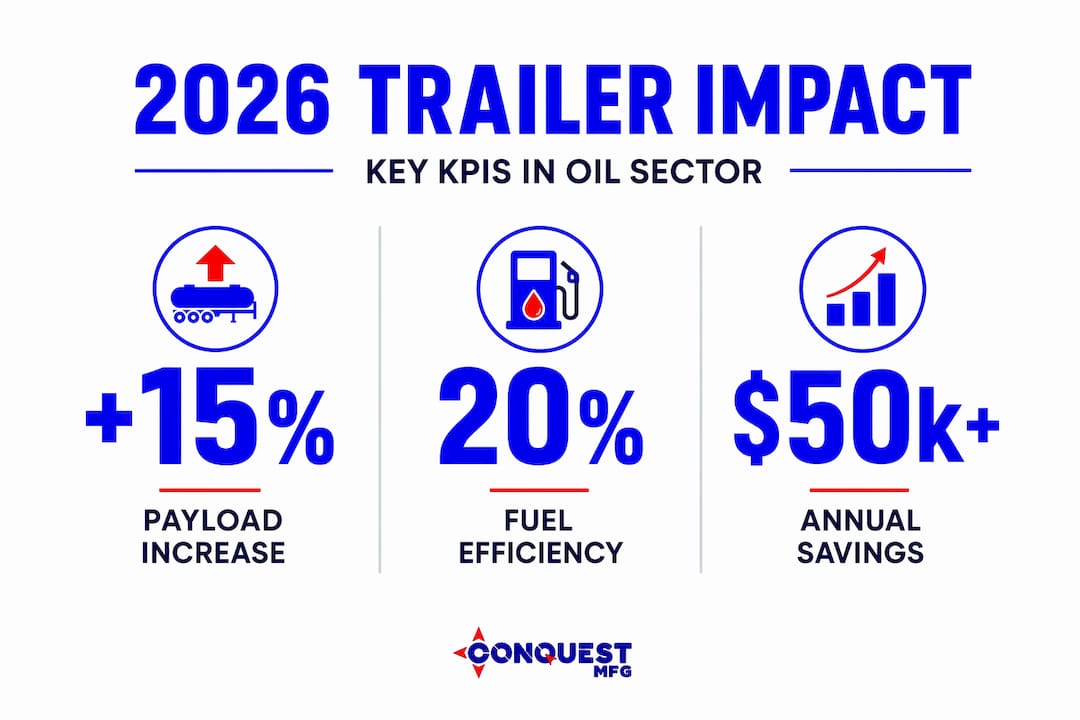
The US semi-trailer market shows growing demand for specialized configurations tailored to oil and gas applications. Tankers, flatbeds, and lowboys designed specifically for oilfield use command higher acquisition costs but deliver better lifecycle economics compared to general-purpose alternatives that require constant modification.
| Economic Factor | Impact on Operations |
|---|---|
| Lightweight aluminum chassis | Higher payload per trip, lower fuel cost per mile |
| Aerodynamic trailer design | Measurable fuel savings at highway speeds |
| Predictive maintenance systems | Reduced unplanned downtime and repair costs |
| Compliance-built vapor recovery | Avoidance of fines and terminal rejection fees |
| Specialized compartmentalization | Ability to batch multiple products per trip |
The emerging energy transition is already reshaping trailer demand alongside traditional petroleum logistics. Hydrogen and electric heavy-duty transport are driving demand for specialized high-pressure tube trailers required for hydrogen refueling infrastructure. Operators who understand this shift now will be positioned to serve dual markets as the energy mix evolves through the 2030s.
The importance of trailers in oil transport extends beyond moving product. Trailers function as mobile storage, temporary containment, and field supply platforms in remote drilling environments where fixed infrastructure does not exist. In that context, trucking solutions for oil sector operations must prioritize adaptability as much as load capacity.
Operators investing in aerodynamic and lightweight trailers consistently report reductions in fuel consumption per ton-mile. These gains compound over large fleets and long contract periods into significant cost advantages.
Best practices for trailer performance and compliance
Optimizing trailer performance in oil operations requires discipline at three levels: pre-trip preparation, in-service monitoring, and post-trip documentation.
Pre-trip inspection priorities for oil tanker trailers:
- Inspect all tank fittings, manhole covers, and bottom valves for seal integrity
- Verify vapor recovery connections match the receiving terminal’s specifications
- Check overfill prevention sensors and confirm alarm functionality
- Test grounding cable and bonding reel for continuity
- Confirm compartment labels match the product load manifest
Pro Tip: Build a site-specific coupling reference sheet for every terminal in your network. Digital tools providing exact vapor recovery requirements before arrival eliminate the guesswork that causes delays and safety incidents at loading racks.
Maintenance workflows should be structured around condition data, not fixed schedules. Real-time trailer connectivity produces brake wear data, temperature readings, and pressure measurements that allow maintenance teams to intervene before failure rather than after. This is how leading fleets are reducing the frequency of roadside inspections and out-of-service violations.
Integration of digital fleet management tools also supports compliance reporting. Automated inspection logs, driver certification tracking, and maintenance history records become audit-ready without manual assembly. For policymakers evaluating fleet safety standards, this data layer represents the most reliable evidence base for enforcement decisions.
Finally, trailer versatility planning matters at the procurement stage. Fleets that can handle crude, refined products, produced water, and oilfield equipment with minimal reconfiguration maintain utilization rates that single-purpose fleets cannot match during commodity price cycles.
My perspective on where oil trailer logistics is heading
I’ve spent a long time watching the oil transport sector treat semi trailers as an afterthought in operational planning. The trailer is ordered, it shows up, and the assumption is that if it holds liquid and has wheels, the job is done. That mindset is becoming untenable.
What I’ve observed is that the gap between high-performing and underperforming fleets in oil logistics is no longer primarily about equipment quality. It is about information quality. The operators who know what their trailers are doing in real time, where the vapor recovery couplings are mismatched, and which compartments are approaching wear thresholds are the ones avoiding fines, keeping terminals happy, and winning long-term contracts.
The regulatory environment will only tighten through the remainder of this decade. Vapor recovery standards, spill prevention requirements, and driver qualification rules are all moving in the direction of greater specificity and stricter enforcement. Trailers that were compliant three years ago may not meet the standards being drafted today.
The transition toward hydrogen and alternative fuel transport is real, but it will not replace petroleum trailer demand in the near term. What it will do is reward operators who have already invested in specialized, adaptable equipment. The oil sector needs more collaboration between fleet operators, trailer manufacturers, and terminal operators to standardize coupling systems, inspection protocols, and data formats. Right now, too much time and money is lost to incompatibility that should have been resolved at the standards level years ago.
— Peter
Purpose-built trailers for oil industry operations
At Conquestmfgusa, we manufacture semi trailers and oil industry equipment designed to perform under the exact conditions this article describes. From steel and aluminum vacuum tanks built for produced water and waste fluid transport to dry bulk pneumatic trailers for frac sand and cement, every unit we produce is custom-built to meet DOT specifications and the operational demands of oilfield logistics.
Our team works directly with operators and procurement teams to tailor trailer configurations for compliance, payload efficiency, and site-specific requirements. Explore our specialized oil industry equipment or visit our transportation industry page to see the full range of solutions we offer. Contact Conquestmfgusa to discuss your fleet requirements and get a quote tailored to your operation.
FAQ
What trailer specification governs petroleum fuel transport?
DOT 406 is the standard specification for petroleum fuel tankers, requiring vapor recovery systems under 40 CFR 63 Subpart CCCCCC and a CDL Class A with an X endorsement for all operators.
What are the EPA penalties for spill prevention non-compliance?
Fines for Clean Water Act violations related to oil spill containment failures can exceed $50,000 per day, making a written SPCC plan a financial necessity, not just a regulatory formality.
How does real-time trailer monitoring improve oil logistics?
Connected trailer platforms integrating brake data, cargo status, and leak detection allow fleet managers to shift from reactive repairs to predictive maintenance, reducing downtime and spill incidents.
Why does material choice matter for oil transport trailers?
Steel offers durability for abrasive or corrosive cargo, while aluminum reduces tare weight and increases legal payload capacity, directly affecting per-trip economics and product compatibility.
What is driving specialized trailer demand in the oil sector in 2026?
Rising freight costs, regulatory tightening, and the emergence of hydrogen transport infrastructure are all pushing operators toward purpose-built, lightweight, and compliance-ready trailer configurations.